 Cronos
 Networks and CRO Uses Across Separate Chains
Cronos is a blockchain ecosystem with separate networks for smart-contract applications and CRO staking, each with its own balances and wallet requirements. Cronos EVM runs Ethereum-compatible applications, while Cronos POS supports payments, non-fungible tokens (NFTs), and native validator delegation. Its separate zkEVM Alpha network is being retired, with shutdown scheduled for June 2027.
A wallet may display assets from several chains together even though each blockchain records its own balance. The distinction affects application access, native staking, and bridging, especially when familiar tickers appear beside different network labels.
Network selection and usable CRO balances
Selecting Cronos EVM makes its native CRO balance available for smart-contract fees, while native delegation uses CRO held on Cronos POS. These are distinct ledgers. A balance on one does not automatically appear as spendable funds on the other, even when both wallets display the same ticker.
CRO also exists as an ERC-20 token on Ethereum. That representation belongs to an Ethereum token contract and cannot directly pay native fees on either of the ecosystem's own chains. Network selection at a custodial withdrawal determines which representation arrives; the destination must support that exact network and asset.
Ethereum execution with Cosmos connectivity
Ethereum-compatible contracts
The Ethereum Virtual Machine, or EVM, lets applications run familiar contract code on a separate blockchain. Solidity is a supported programming language, and developers can reuse common Ethereum tooling. Deployment creates contracts on the chosen chain; an Ethereum deployment does not automatically exist here. Token standards define how applications call those contracts, while each contract's deployed code determines its actual behavior.
Cosmos networking and validator selection
Cosmos SDK supplies the chain's underlying framework, and Inter-Blockchain Communication, or IBC, provides connectivity with compatible Cosmos networks. Each bridge supports a defined set of assets and routes, which can be narrower than the underlying protocol's capabilities. Cronos EVM uses a permissioned validator model commonly called proof of authority. Applications can deploy without becoming validators, so open application development and restricted validator admission describe different parts of the network.
What does CRO power on each network?
CRO pays native transaction fees on Cronos EVM and Cronos POS, and delegated CRO participates in the proof-of-stake network's security.
Gas fees pay for blockchain execution. ERC-20 CRO transfers on Ethereum incur gas fees in ETH; Cronos EVM gas fees are paid in native CRO. Applications using supported gas sponsorship or stablecoin fee payments can let users transact without their own CRO gas balance. An application's trading or liquidity fee is separate from network gas fees. A combined wallet balance does not supply gas across these chains.
Native staking also gives eligible bonded balances a role in on-chain governance. The retiring zkEVM Alpha used zkCRO, a liquid-staked CRO derivative, as its gas asset. Existing withdrawals from that network still need zkCRO.
Applications, stablecoins, and trading products
Decentralized finance and digital assets
Decentralized finance applications use contracts for exchanges, lending, and liquidity pools. VVS Finance is one exchange deployed in the EVM ecosystem, where swaps and liquidity provision operate through its contracts. Non-fungible tokens, or NFTs, and gaming applications also use the network's programmable contracts. Chain compatibility determines where their contracts run; it does not make their liquidity, collateral rules, or token permissions uniform. Depositing into an application creates exposure to that application's contract logic.
Native stablecoin settlement
Native USDC and EURC are available on the EVM network for dollar- and euro-denominated transfers and applications. Circle's Cross-Chain Transfer Protocol, or CCTP, also supports moving native USDC between supported networks. Those currencies provide different settlement assets from CRO, which remains the native fee coin. A stablecoin balance and a native gas balance therefore have different jobs, even when an application displays them together.
Ult and token launches
Ult launched on September 17, 2026, as the renamed Cronos app. Its launch included spot trading, perpetual markets linked to equities, commodities, and crypto, and sports predictions. Available markets vary by jurisdiction; an equities-linked perpetual is a derivative, not a shareholding. Cronos Launch provides a launchpad for new tokens. Launching through it does not guarantee an exchange listing, which remains a separate review decision.
Validator staking and time-locked tiers
Delegation, commission, and slashing
Delegating native CRO to an active validator supports the proof-of-stake chain without requiring the holder to operate a node. Validators propose and sign blocks, and delegators share rewards under the chain's rules. Validator commission affects ordinary reward distributions. Misbehavior can trigger slashing that reduces delegated principal, making validator performance relevant to both rewards and the amount ultimately available to withdraw. A staking balance is not the same state as a freely transferable balance.
Optional tier commitments
The May 2026 v7 upgrade added optional time-locked tiers on top of native delegation. Existing ordinary delegations can remain in the base tier or commit to a tier without first unbonding. Tier participants retain voting rights, and standard slashing rules still apply. A tier's commitment governs access to principal; rewards can still be claimed at any time. Bonus reward rates depend on governance and available funding. The exit commitment countdown starts when the holder requests exit, rather than when the position opens. After it ends, the holder can return the position to base delegation or begin ordinary unbonding to receive transferable CRO.
Ordinary unstaking makes funds transferable only after the chain's unbonding period. Moving a delegation between validators changes its assignment, while transferring CRO to another network changes the ledger that holds the asset.
Can an Ethereum wallet connect to Cronos EVM?
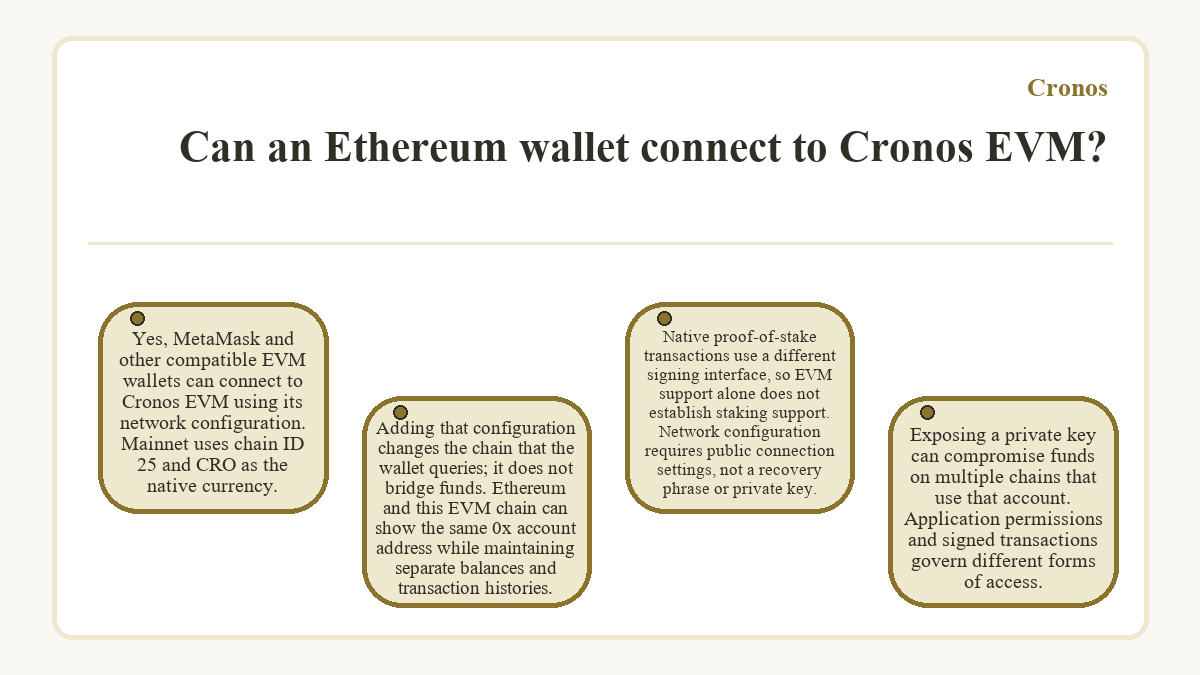
Yes, MetaMask and other compatible EVM wallets can connect to Cronos EVM using its network configuration. Mainnet uses chain ID 25 and CRO as the native currency. Adding that configuration changes the chain that the wallet queries; it does not bridge funds. Ethereum and this EVM chain can show the same 0x account address while maintaining separate balances and transaction histories.
Native proof-of-stake transactions use a different signing interface, so EVM support alone does not establish staking support. Network configuration requires public connection settings, not a recovery phrase or private key. Exposing a private key can compromise funds on multiple chains that use that account. Application permissions and signed transactions govern different forms of access.
A balance for application gas or delegation
In a hypothetical case, a wallet holds the native fee coin only on the EVM chain, and its owner wants validator delegation on the proof-of-stake chain.
The EVM balance belongs to the ledger that processes smart-contract calls. It can fund native application gas there. Delegation operates on the separate proof-of-stake ledger and requires the asset in that chain's native form.
That holding is usable for gas fees on its present chain and unavailable for native delegation on the other chain. This remains true while the funds stay only on the EVM chain. Renaming a wallet entry or switching its view leaves that representation unchanged.
zkEVM Alpha withdrawal window
Cronos zkEVM Alpha entered a wind-down period in June 2026 as development shifted toward Cronos EVM. The Cronos zkEVM Alpha shutdown is scheduled for June 3, 2027, at 03:00 UTC. The scheduled closure concerns the Alpha network; Cronos EVM and Cronos POS remain separate operating chains.
The Alpha was developed as an Ethereum layer-2 chain using ZK Stack technology. Its shutdown plan disables new bridge deposits and retains withdrawals during the transition, subject to operational, technical, and security conditions. Existing holders still need zkCRO to pay withdrawal gas.
Applications can follow their own closure timelines within that broader window. Core network availability does not keep every application open until the shutdown date. Assets left on the Alpha network after final shutdown will no longer be recoverable.
A zkCRO withdrawal can deliver LCRO, a liquid-staking token, before conversion to CRO. That intermediate balance has its own token identity; receiving it does not establish that the wallet already holds spendable native CRO.
Governance changes and application access
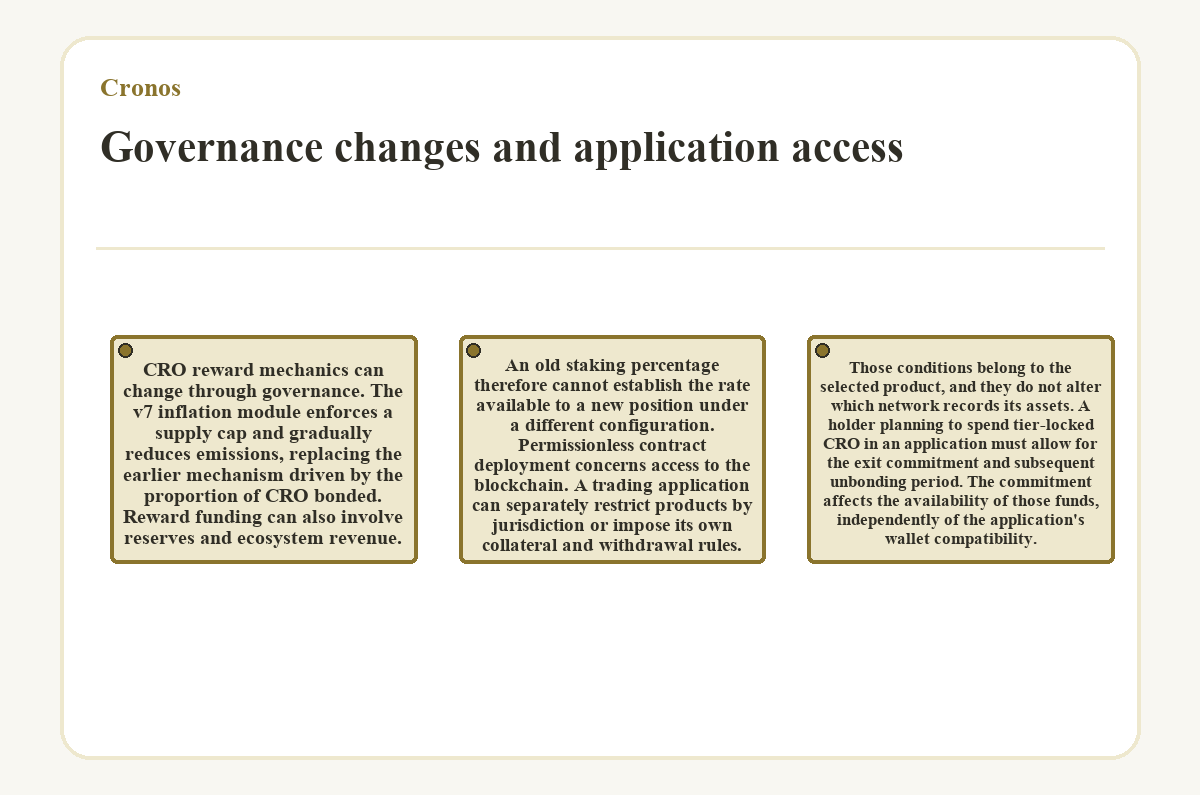
CRO reward mechanics can change through governance. The v7 inflation module enforces a supply cap and gradually reduces emissions, replacing the earlier mechanism driven by the proportion of CRO bonded. Reward funding can also involve reserves and ecosystem revenue. An old staking percentage therefore cannot establish the rate available to a new position under a different configuration.
Permissionless contract deployment concerns access to the blockchain. A trading application can separately restrict products by jurisdiction or impose its own collateral and withdrawal rules. Those conditions belong to the selected product, and they do not alter which network records its assets.
A holder planning to spend tier-locked CRO in an application must allow for the exit commitment and subsequent unbonding period. The commitment affects the availability of those funds, independently of the application's wallet compatibility.
Helpful answers about Cronos
When is a memo required for a native CRO deposit?
Use a memo when the receiving platform lists it for a native proof-of-stake CRO deposit. Custodial services can require both an address and a memo to identify the account that should receive credit. A personal wallet generally does not use that account-routing requirement. The recipient's deposit details determine whether the field is necessary.
Can a Ledger device sign CRO delegation transactions?
Ledger devices can sign native CRO delegation transactions through a compatible wallet such as Keplr. The setup must support the proof-of-stake chain and its signing format. An Ethereum-capable hardware setup alone does not establish that support; the connected wallet software and device application must handle the native chain's transactions.
Are testnet tCRO balances spendable on mainnet?
Testnet tCRO cannot pay mainnet transaction fees. The EVM mainnet uses CRO on chain ID 25, while its testnet uses tCRO on chain ID 338. Selecting a different wallet network changes the displayed ledger; it does not convert test funds into mainnet funds.
How can a received token be absent from a wallet's asset list?
A wallet can hold a token on-chain without displaying it automatically in its asset list. Token detection varies by wallet and network, and an unlisted ERC-20 token may require importing its contract address. That display change does not transfer or mint tokens. The contract address and selected chain identify the balance that the wallet should show.
Does disconnecting a decentralized application cancel its token allowances?
Disconnecting a decentralized application does not cancel existing on-chain token allowances. An ERC-20 allowance authorizes a specified spender to transfer that token up to the remaining approved amount. Removing that permission requires an on-chain allowance change or revocation. Its scope concerns the approved token and spender, rather than every asset in the wallet.
What distinguishes native USDC from USDC.e on the EVM chain?
Native USDC is issued directly on the EVM chain, while USDC.e identifies bridged USDC there. They have different contract addresses and can occupy different pools or supported deposit routes. Circle's CCTP moves supported native USDC between chains. An application that accepts one representation does not necessarily accept the other, despite their related dollar denomination.
Did the Cronos coin rebrand change the CRO ticker?
The February 2022 coin rebrand adopted the name Cronos while retaining the CRO ticker. The name change did not merge balances across blockchains. Native CRO on the ecosystem's chains and the ERC-20 representation on Ethereum still have different network requirements.